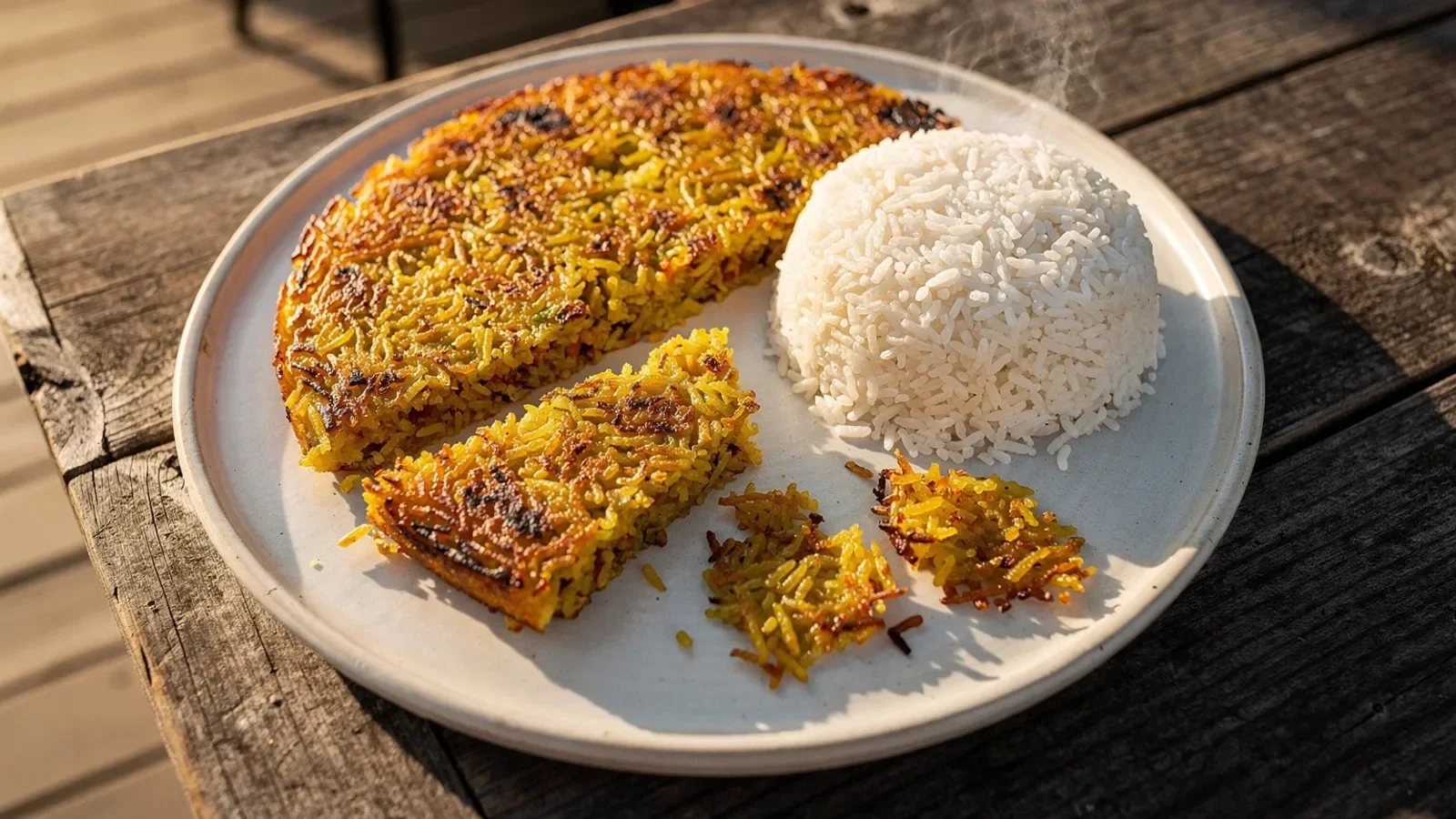
Tahdig is the golden, crunchy layer of rice that forms on the bottom of the pot when Persian rice is steamed slowly in fat, then flipped out crust-side up. If you’re in Glendale wondering what is tahdig, that’s the full answer. It’s the prized part of the pot, served in shards beside fluffy rice and kabobs.
What does tahdig mean?
Tahdig means “bottom of the pot” in Persian. The word joins tah (bottom) and dig (pot). That’s it. The name describes exactly where the crust comes from.
The literal meaning matters because it tells you how the dish works. Tahdig is not a separate recipe cooked on its own. It’s the layer that forms where the rice touches the hot base of the pot during a long, gentle steam. Everything above it becomes light, separate grains. Everything at the very bottom turns crisp and golden.
In many Iranian households the tahdig is the piece people reach for first. It’s often the first thing to vanish from the platter. Some families treat cutting it as a small ritual at the table. You’ll hear it called the best part of the rice, and the name is just a plain label for that crunchy reward.
What is tahdig made from, and how does it get so crispy?
Classic tahdig is made from long-grain rice, fat (butter, oil or both) and the steam of the pot itself. Some versions add a base layer of something else to crisp instead of plain rice. The short answer: rice, fat, time and low heat.
Here is why it crisps. Persian rice is usually parboiled, drained, then mounded back into a pot with fat coating the bottom. A cloth-wrapped lid traps steam while keeping drips off the rice. Over a long, slow cook, the top grains steam fluffy and the bottom layer fries in the fat. When the pot is turned out, the crust comes away as one golden disk.
Common variations:
- Plain rice tahdig. Just grains, often brushed with saffron for color.
- Yogurt and saffron tahdig. A layer of rice mixed with yogurt and egg for a richer, thicker crust.
- Potato tahdig. Thin potato slices line the pot and turn crisp like chips.
- Bread tahdig. Flatbread lines the bottom for an extra-crunchy base.
Each version tastes different. All of them share one goal: a crust that shatters, sitting under rice that stays soft.
Is Persian rice the same as basmati rice?
No, but they overlap. Persian rice is a cooking style and a family of Iranian long-grain varieties, while basmati is a specific aromatic long-grain rice. Many cooks outside Iran use basmati to make Persian-style rice because it behaves similarly.
The difference shows up in the method. Persian rice is soaked, parboiled, drained and steamed, which gives long, separate, fluffy grains and makes tahdig possible. Basmati cooked by simple absorption, the way many people make it at home, won’t give you that same texture or a crust.
Iranian varieties are prized for fragrance and for grains that lengthen as they cook. They can be harder to find in the US, so basmati is the common stand-in. Skip the debate over which is “real.” The technique carries more of the result than the bag does. Good Persian rice is defined by how it’s cooked as much as by which grain is used. For more on what separates careful rice from shortcuts, see {{sibling:how-to-order-persian-rice-glendale|how to order Persian rice with confidence}}.
What is texmati rice?
Texmati is a trade name for an American basmati-style long-grain rice grown in Texas. It was developed to bring basmati’s aroma and long grains to a rice that grows well in US conditions.
It sits between ordinary American long-grain and imported basmati. The grains are long and cook up fairly separate, with a milder aroma than traditional basmati. Some home cooks use it for pilafs and everyday rice.
Can it make tahdig? It can form a crust, since any parboiled long-grain rice steamed in fat on low heat will crisp at the bottom. The texture of the top rice tends to be a bit less fluffy and fragrant than with basmati or Iranian rice. If you’re chasing the classic result, most cooks reach for basmati or an Iranian variety. If you just want to try the method, texmati works as a practice grain.
What are the top 5 Persian dishes?
Five dishes come up again and again as Persian classics: chelow kabob, ghormeh sabzi, fesenjan, zereshk polo and joojeh kabob. Tahdig shows up alongside most of them.
- Chelow kabob. Steamed rice served with grilled kabob, often koobideh (seasoned ground meat on skewers). Widely considered a national dish.
- Ghormeh sabzi. A slow-cooked herb stew with kidney beans, dried lime and meat.
- Fesenjan (fesenjoon). A stew of ground walnuts and pomegranate molasses, rich, tangy and slightly sweet.
- Zereshk polo. Saffron rice studded with tart barberries, traditionally paired with chicken.
- Joojeh kabob. Saffron-marinated chicken grilled on skewers.
Lists like this vary by family and region. Still, these five give a good picture of the cuisine: grilled meats, herb-heavy stews and rice treated as a main event. If the barberry rice catches your eye, read {{sibling:zereshk-polo-flavor-profile-glendale|what zereshk polo actually tastes like}} before you order it.
Where does tahdig fit in a Persian meal?
Tahdig is served as part of the rice course, broken into pieces on top of or beside the fluffy rice. It isn’t a standalone main. It’s the crunchy contrast to everything soft on the plate.
Think of the plate in layers. Fluffy saffron-streaked rice is the base. Kabobs or a stew bring the protein and sauce. Tahdig adds the crunch. A spoonful of stew poured over a shard of tahdig softens the edge while the center stays crisp, and many diners eat it exactly that way.
Pairing matters. A juicy koobideh beside plain chelow with a piece of tahdig is a classic combination. A tart stew like fesenjan works well with a rich yogurt-saffron crust. Our guide to {{pillar_url|traditional Persian rice dishes}} walks through how each rice style matches a kabob or stew.
Do this when you sit down: ask whether the tahdig comes with the rice or on its own, since serving styles differ. Then plan the rest of the order around it. The pillar guide on {{pillar_url|matching rice styles with grilled kabobs}} covers that step in detail.
Tahdig on a Glendale table
Glendale is a good place to learn tahdig because Persian food here is part of everyday life, not a novelty. The wider Los Angeles area is home to one of the largest Iranian communities outside Iran, and Glendale sits right in that orbit.
That shapes what you’ll find. Persian dishes, ingredients and vocabulary are familiar here, so words like tahdig, chelow and polo are easy to use when ordering. You don’t need to explain yourself.
Climate matters too, in a practical way. Glendale’s fall and winter evenings are mild but cool, and a warm plate of rice with a fresh crust suits that weather. Outdoor tables are common in the area, and they work well for a kabob-and-rice meal.
One real-world tip: tahdig is at its best fresh. Steam trapped in a closed takeout container softens the crust fast. If you take rice home, open the lid a bit on the drive and eat the crisp pieces first. Stored rice is a different story, so plan accordingly.
Ready to taste it for yourself? Check what’s on the menu and {{service|plan a Persian rice and kabob meal in Glendale}} with tahdig at the center of the plate.