It is less about heavy seasoning than most people think. The real fresh ground koobideh signs in Glendale come down to a spongy, springy crumb structure held together solely by rendered animal fat and squeezed grated onion. Use this checklist to evaluate meat quality, moisture retention, and binder-free preparation on your plate. Start with the single most important test: checking the interior cross-section for natural protein knitting without bread fillers.
Visual fresh ground koobideh signs on the plate
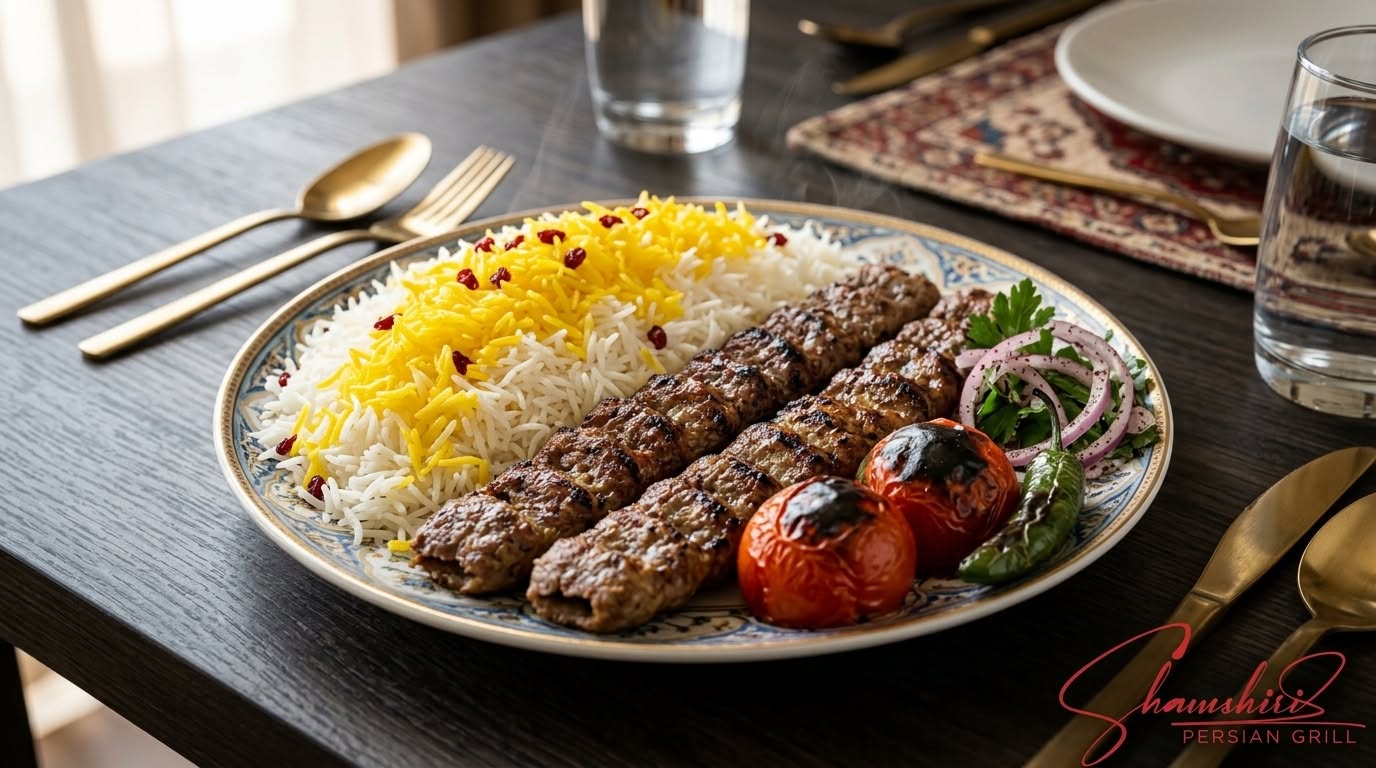
Look at the exterior of the skewer before you cut into it. A properly ground and mounted kabob reveals its preparation history through its surface geometry, color transitions, and fat droplets.
- Inspect the ridge patterns for sharp thumb indentations. Traditional preparation requires the cook to press the meat mixture onto a wide, flat stainless steel skewer using the thumb and index finger. Those indentations (called band in Persian kitchens) should look slightly rounded and uneven from human hands. They are never stamped by an extrusion machine. When meat is freshly ground, the protein fibers are sticky enough to hold these deep ridges through the intense heat of the grill.
- Check the edges for natural tapering rather than squared-off ends. Hand-mounted skewers taper gently at the top and bottom. There, the cook seals the meat onto the metal blade to keep it from sliding off over the fire. Pre-formed or frozen commercial cylinders usually have blunt, machine-cut ends that look uniform across every plate in the dining room.
- Look for glistening beads of clear fat in the valleys of the meat. A proper koobideh mixture relies on a high fat ratio, typically around twenty to twenty-five percent animal fat, often combining beef chuck or brisket with lamb shoulder or tail fat. As the skewer roasts, that fat renders and pools in the thumb indentations. Watch for a matte, chalky, or dry surface the moment it hits the table. That means the grind was either too lean or previously frozen, which ruptures cell walls and dumps moisture into the fire.
- Verify that the char sits only on the high ridges. Heat radiation from the grill bed should blister the raised ripples a deep mahogany brown while leaving the recessed grooves a lighter roasted shade. This two-tone surface shows the meat swelled naturally on the skewer during cooking. You can learn more about how fire management creates this finish in our guide to authentic Persian skewers.
- Examine the bottom of the kabob for the flat skewer channel. Because the meat is wrapped around a wide flat iron or steel blade, pulling the metal out leaves a distinct hollow slot running through the center. That inner channel should look moist and intact. If the channel has collapsed completely or tore open along the seam, the mixture lacked the myosin protein bond that comes from kneading fresh meat right after grinding.
- Watch for a slight saffron or sumac bloom on the surface oil. Many kitchens brush a tiny amount of melted butter and brewed saffron across the hot meat right as it leaves the fire, or dust it with ruby-red sumac. The oil on the meat should stay clear and translucent. Cloudy or gummy residue on the surface points to starch binders or chemical tenderizers pushing out during cooking.
Texture and structural checks when you cut with a fork
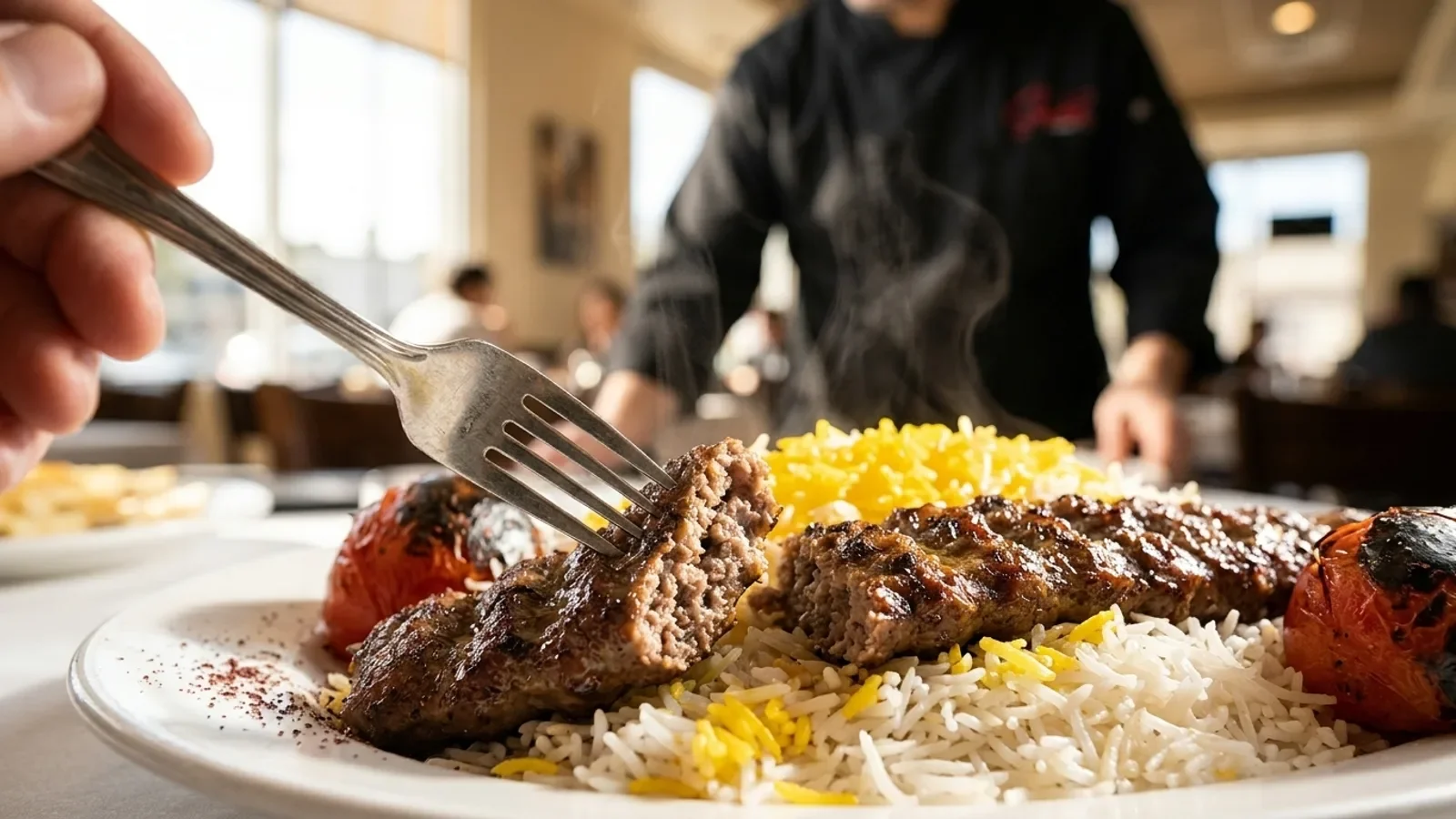
Put the knife aside. In traditional Persian dining, you break and section a minced kabob using only the edge of a fork or a piece of flatbread. How the meat yields tells you everything about the grind size and how long the batch sat before cooking.
- Press the center with the back of your fork to test for springback. Freshly ground beef and lamb that have been double-ground through fine plates and hand-kneaded develop an elastic protein mesh. When you press down, the meat should compress slightly and bounce back. Do this first. If your fork sinks into a mushy paste or hits a rock-hard wall, the batch was either overworked in a high-speed food processor or packed with bread crumbs.
- Break a piece off with the side of a fork and inspect the tear line. Do not slice cleanly with a knife, as a sharp blade hides texture flaws by shearing the fibers flat. Tearing with a fork exposes the actual crumb. You want to see tiny, distinct granules of meat clinging together in a coral-like structure, not a smooth, hot-dog-style emulsion.
- Look for microscopic air pockets inside the cross-section. When meat goes through a dedicated meat grinder twice and gets folded by hand with grated onion, tiny air pockets trap inside the paste. As the fat melts on the fire, it bakes through those pockets. That makes the bite light and tender. A solid, dense wall of gray meat with zero porosity means the mixture was compressed too tightly or spun with blades instead of pushed through a grinding die.
- Check the resistance between the exterior crust and the interior crumb. There should be a gentle snap on the very outer blistered ridge, followed immediately by a soft, yielding interior. That contrast is difficult to fake. It requires high radiant heat hitting raw, cold, freshly mounted meat. Read how fuel choice affects this crust in our comparison of gas versus charcoal Persian grilling methods.
- Ensure the skewer holds together when lifted by one end with lavash. Grab a three-inch section of the kabob using a piece of bread and lift it off the rice. Properly bound fresh meat has enough tensile strength from its own salt-extracted proteins to stay in one piece. If it crumbles into loose taco-meat granules on the plate, the fat ratio was wrong. Either the onion juice was not squeezed out properly, or the meat was old before it was ground.
- Test for gristle or unground sinew in the bite. High-quality preparation starts with trimming silver skin and heavy connective tendons from whole cuts before they ever touch the grinder hopper. Even a fine grinding plate cannot hide tough sinew. Every bite should melt uniformly with zero rubbery bits left behind.
Aroma, onion prep, and binder warning signs
A real minced skewer contains just four core ingredients: meat, fat, grated onion, and salt (plus black pepper and occasionally a touch of turmeric or baking soda in some regional styles). Anything else is a shortcut. Those extras are designed to keep poorly prepped meat from falling into the coals.
- Sniff the broken center for sweet roasted allium rather than sour raw onion. Onion is the backbone of the flavor profile, but its water content is the enemy of skewer stability. Cooks must grate or finely pulp the onions and press them through cheesecloth or fine mesh to drain the liquid, keeping only the dry onion pulp. When done right, that pulp caramelizes inside the meat and smells sweet and savory. A sharp, acidic, or gassy center is a bad sign. It means raw onion juice was left in the mix and boiled the meat from the inside out.
- Taste for a clean beef-and-lamb finish without starchy aftertastes. Take a small bite without rice, bread, or grilled tomato. Focus on how it coats your palate. Pure meat and animal fat leave a rich, clean savory coat that clears quickly with a sip of tea or doogh. If a gummy film sticks to the roof of your mouth, the kitchen added flour, bread crumbs, soy protein, or mashed potato to absorb excess liquid and stretch the batch.
- Check the color of the interior crumb for natural brownish-pink tones. The USDA safe minimum internal temperature chart specifies 160°F for ground beef and lamb. Even when cooked all the way through to food-safe temperatures, pure minced meat retains a natural roasted umber hue. A pale yellow, tan, or beige interior is a classic giveaway of heavy breadcrumb, chickpea flour, or egg binders diluted into the meat.
- Verify that the spice level does not mask the meat flavor. Traditional Persian minced kabobs are not heavily spiced like some Levantine, Turkish, or South Asian variations. You should not taste heavy cumin, coriander, chili paste, garlic powder, or cinnamon in standard koobideh. Commercial kitchens frequently use heavy spice blends to disguise oxidized fat or frozen meat that has lost its natural sweetness.
- Look for excess watery purge pooling under the rice. A few drops of golden rendered fat and saffron butter should stain the white basmati rice underneath the skewer. However, you should never see a puddle of thin, gray, watery liquid collecting on the porcelain plate. Watery purge indicates the meat was frozen and thawed after grinding, or treated with phosphate water-retaining solutions.
- Note how the fat behaves as the plate cools after ten minutes. Real lamb and beef tallow begin to set into a firm, waxy sheen as the temperature drops toward room temperature. Watch the plate twenty minutes into the meal. If the grease stays completely liquid and slick like vegetable oil, cheap liquid cooking oils were likely whipped into lean meat to simulate fat content.
Glendale-specific considerations for evaluating Persian skewers
Glendale and the surrounding Verdugo Mountains basin have one of the highest concentrations of Persian, Armenian, and Middle Eastern grill kitchens in Southern California. That local density changes what you should look for as a diner. It matters whether you are eating in a bustling dining room near Brand Boulevard or carrying takeout home up the hills toward Montrose and La Crescenta.
- Account for low San Fernando Valley humidity when ordering takeout. Dry Southern California air pulls surface moisture out of hot proteins rapidly, especially during autumn and winter Santa Ana wind events. A genuinely fresh ground skewer with proper natural fat emulsion will hold its internal juiciness during a fifteen-minute drive across Glendale. A lean or filler-heavy skewer turns to leather before you unpack the bag.
- Inspect the bread layer in delivery boxes to judge moisture balance. Local restaurants typically pack skewers over or under large sheets of lavash or sangak inside foil-lined containers. Lift the top piece of bread immediately. It should be softened by clean steam and dotted with orange saffron fat, not soaked through with gray onion water that causes the kabob to steam itself into a spongy brick during transit.
- Watch how high-volume dining hours affect batch resting time. After grinding and mixing with onion pulp, authentic kabob paste must rest in refrigeration for several hours. This allows the proteins to cross-link and chill firm enough to cling to the metal blade over open fire. In busy Glendale dining corridors on weekend evenings, rushed batches that skip the cold-rest window often show tearing along the skewer edges or uneven thickness from top to bottom.
- Check local health and ventilation realities around indoor live-fire cooking. Operating solid-fuel grills in Los Angeles County requires strict adherence to South Coast Air Quality Management District (AQMD) emissions rules and county health codes. Understanding how charcoal grilling works in Glendale helps you recognize the subtle smoky aroma and blistered crust that come from a properly vented, high-heat hearth rather than an electric broiler.
- Use a dry skillet or oven method when testing leftovers the next day. Glendale portions frequently yield a second meal. How the meat performs the following afternoon is the ultimate test of its grind quality. Pure ground meat with natural fat rebounds well when warmed gently, while breadcrumb-stuffed versions dry out and split. Follow proper steps for identifying properly charcoal grilled koobideh kabobs on day one so you know what quality baseline you are working with before saving leftovers.
Frequently Asked Questions About Fresh Ground Koobideh Signs
What type of meat is traditionally used in shish kebab?
Lamb is the most traditional meat used for shish kebab across Persian and Middle Eastern cooking, commonly cut from the leg or shoulder for whole-muscle skewers. Minced skewers like koobideh require a different blend. Cooks traditionally use a combination of fatty beef chuck and lamb shoulder or lamb tail fat to balance structure and richness.
What exactly is kebab?
Kebab refers to a wide family of dishes consisting of cut, cubed, or ground meat, and sometimes poultry, fish, or vegetables, cooked on skewers over direct heat or roasted near a fire. The term originated in the Middle East. It covers everything from whole marinated tenderloin fillets (barg) to hand-mounted minced meat cylinders (koobideh).
Is galouti kebab beef?
Galouti kebab is a South Asian minced meat patty from Lucknow, India, traditionally made with finely pasted mutton, goat, or water buffalo beef mixed with raw papaya tenderizer and dozens of roasted spices. Persian koobideh is cooked on a flat metal skewer over open flames with only onion, salt, and pepper. Galouti, by contrast, is pan-seared on a flat griddle until melt-in-the-mouth soft.
If you want the job done right the first time, consider professional menu services in Glendale.
Why does koobideh fall off the skewer during cooking?
Minced meat falls off the skewer into the fire when the mixture contains too much water from unpressed onions, lacks the proper twenty-percent fat ratio, or was not kneaded long enough to activate sticky myosin proteins. Temperature also plays a critical role. Using warm meat that was not chilled after grinding causes the fat to melt before the outer crust can set around the metal blade.
What Glendale diners should check before ordering
Glendale sits at the crossroads of major Armenian, Persian, and Levantine culinary traditions, which means local menus often place Persian koobideh, Armenian lule, and Arabic kafta side by side. While all three are minced meat skewers, their formulation rules differ. Kafta frequently includes chopped fresh parsley and garlic, while true koobideh relies strictly on squeezed grated onion, salt, black pepper, and high-fat double-ground beef and lamb. Knowing which style you are ordering ensures you apply the right visual and texture checklist when the platter arrives.
Apply this checklist on your next dinner out to tell hand-prepped, binder-free skewers apart from mass-produced shortcuts. Visit Shamshiri Persian Grill Glendale to explore traditional Persian dining in the heart of Glendale, CA.